
I.N 'NO RETURN': Look Back Once, and the Stairs Belong to Someone New
Stray Kids I.N 'NO RETURN' MV meaning, SKZ-PLAYER songwriting and direction craft, beside Orpheus in Ovid's Metamorphoses
Stray Kids I.N's 'NO RETURN' meaning: a self-written synth-pop spell, a fake-drop chorus, and an MV he helped direct that turns Orpheus's fatal glance into the birth of a new self, read beside Ovid's Metamorphoses.
 No. 0040
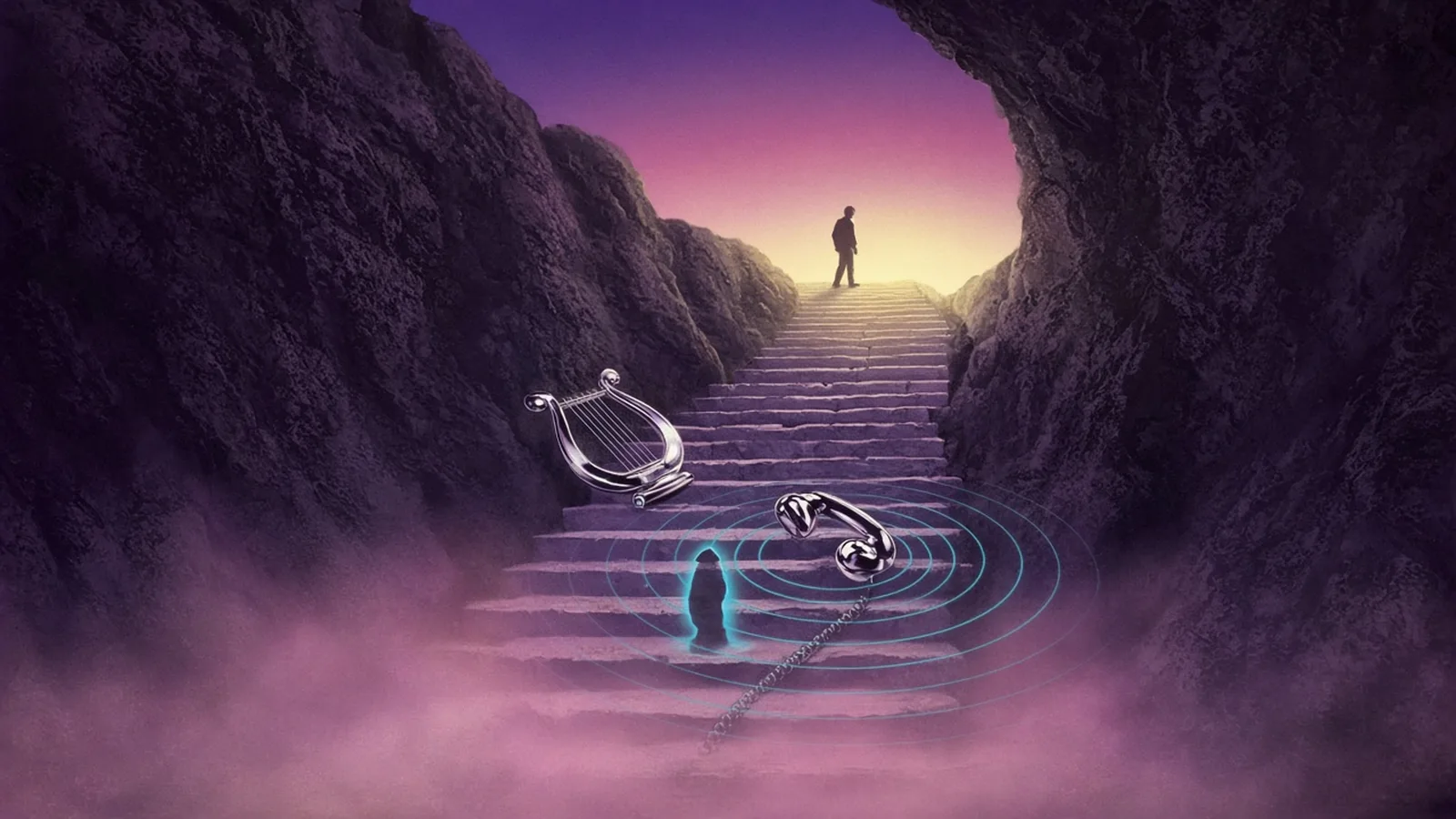
Cover art No. 0040 · Original artwork for Idol Regalia
“Orpheus lost everything by turning around. I.N turns around on purpose, and lets the one who was waiting on the stairs win.”
A ringtone that will not stop. A staircase out of the dark. One look back, and no return.
On November 17 at 6 p.m. KST, Stray Kids' I.N released the digital single "NO RETURN" and its music video on the group's official YouTube channel. It is the third chapter of SKZ-PLAYER, the project JYP Entertainment describes as the eight members' surprise gifts to their fandom, STAY: music they want to share, made with their own hands. Han opened it in June with "back to life," and Felix followed in September with "Slow It Down."
This time the youngest member did not only sing. JYP says I.N took part in the lyrics, the composition, and the planning and direction of the music video. Stagecraft reads what he built, beside the most famous backward glance in Western literature: Orpheus on the path out of the underworld, as Ovid told it in the Metamorphoses.
The song: a spell, sung lightly
The official credits list I.N and Bang Chan of 3RACHA as lyricists, and Bang Chan, I.N and VERSACHOI as composers, with VERSACHOI and Bang Chan arranging. JYP calls it a synth-pop track with an easy, slowly absorbing mood, and Bang Chan's comment names the design: a high riff that recalls a phone ringtone against a heavy, textured bass. Where the build-up promises an explosion, the chorus uses a fake drop to hold the energy back, and the post-chorus switches to vocals repeated "like a spell."
The lyrics, as printed on the official video, are a calm refusal to be refused. "You can't go back anymore." Then the three rejections in quotation marks, "'I hate you' 'Just get lost' 'I don't need you'," and the answer that no matter how many times you say it, "you're back again." I.N's own note explains the tone: confidence that once you fall in, you cannot get out, told with "a slightly playful, relaxed attitude," and with restrained expression so the song's poise comes through (our translation).
Applause for that restraint. A song this sure of itself could have shouted. Instead the fake drop leaves a silence where the drop should be, and the hook does what a ringtone does: it simply keeps calling until you answer.
https://x.com/Stray_Kids/status/2122253346744709552
The MV: Orpheus, turned inside out
JYP's release notes describe the video plainly. One person holds two selves, an original self and a "mad" self, and the two collide. The video borrows the Orpheus myth, which JYP says reveals the song's title intuitively: at the moment he looks back, the mad self swallows him. The last performance on a staircase is the finale, the new self's victory and the former self's disappearance made visible. The ending, in which the mad self takes over the body, is "a loss and at the same time a liberation" (our translation).
That last phrase is the key to the craft. Tenasia and Dailian both report that I.N joined the planning and direction to tell the song's story in images. He chose a myth everyone knows ends in failure, and then moved the camera to the other side of the glance.
Beside Ovid: "and at once she slipped back"
In Book X of the Metamorphoses, Orpheus sings his way into the underworld to bring back Eurydice. The gods agree, with one condition (our translations from the Latin):
"that he not turn his eyes back until he had left the valleys of Avernus, or the gift would be void."
Then Ovid gives the road, and it is a staircase in all but name:
"Through the mute silences they climb the uphill path, steep, dark, thick with murky fog."
And then the line that has haunted every artist since:
"afraid she might falter, and eager to see her, the lover turned his eyes, and at once she slipped back."
In Ovid, the backward look is the moment of loss. The gift is void; there is no return. "NO RETURN" keeps every element, the climb, the dark, the single glance, and reverses the weight. Orpheus lost everything by turning around. I.N turns around on purpose, and lets the one who was waiting on the stairs win.
ACROSS ASIA
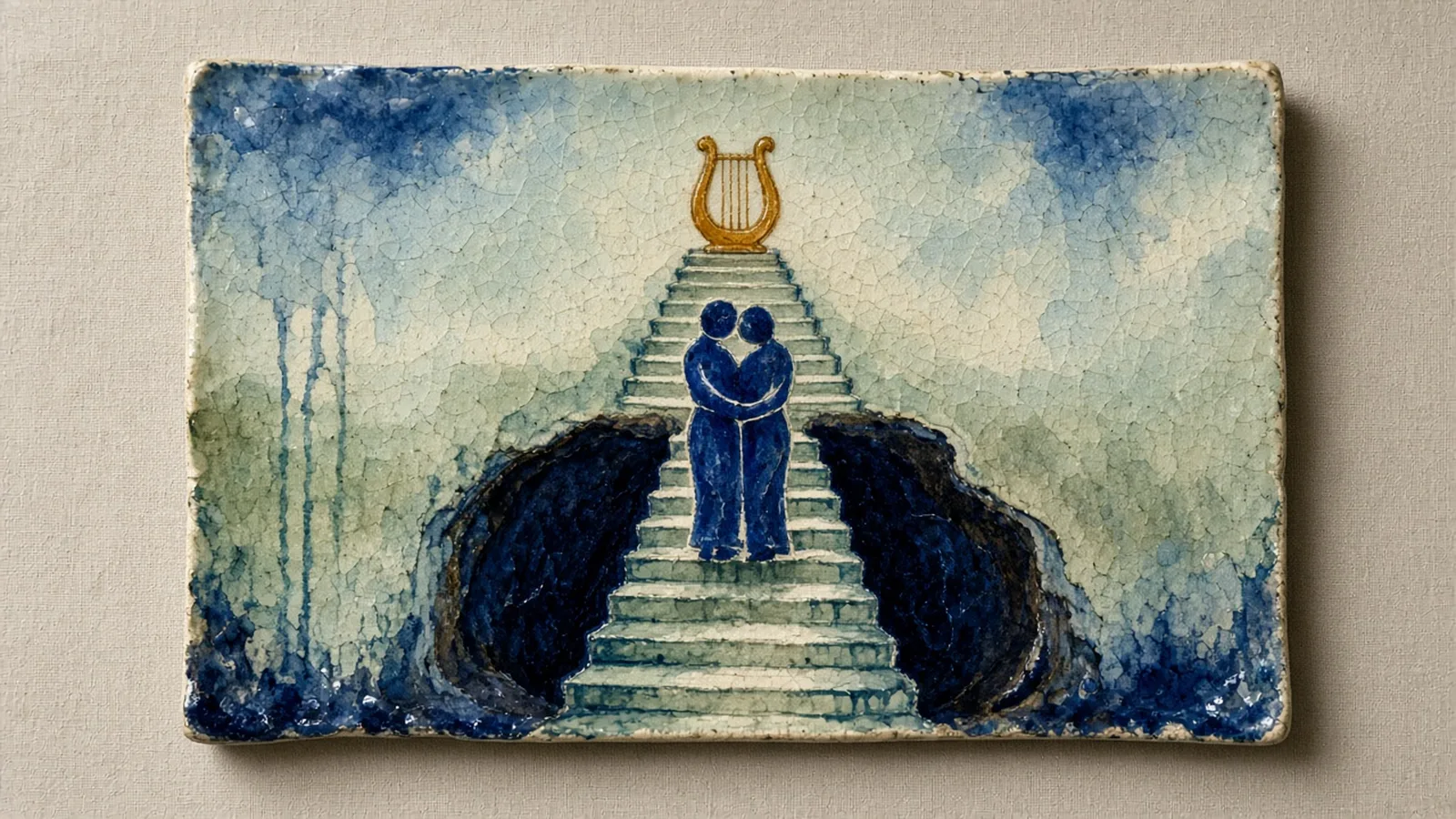
Japan's oldest chronicle tells its own story of a forbidden look on the road from the dead. In the Kojiki (c. 712), the god Izanagi follows his wife Izanami into Yomi, the land of the dead. As Wikipedia summarizes the myth, she tells him it is too late, since she has eaten the food of the underworld, but agrees to ask for permission to leave. He cannot wait in the darkness: he lights the comb from his hair as a torch, sees what she has become, and flees, sealing the slope between the worlds with a great boulder. Two mythologies, west and east, agree that the glance back is the point of no return. "NO RETURN" takes that ancient agreement and asks what is born on the near side of it.
Where the comparison stops
- Orpheus and Eurydice are two people; the MV, per JYP, stages two selves inside one person. We borrow Ovid's road and glance, not his tragedy of a lost wife.
- The Ovid lines are our translations of the Latin text of Metamorphoses X.51–57 at The Latin Library. The Izanagi summary follows Wikipedia's account of the Kojiki version.
- English lyric lines follow the lyrics printed on the official video; I.N's and Bang Chan's comments are our translations of JYP's release notes.
- JYP states that the MV borrows the Orpheus myth. The reading beside Ovid's specific lines and the Kojiki is our editorial comparison, not a claim about the makers' sources.
A fresh perspective: SKZ-PLAYER as a stage for authorship
Aju Press, citing JYP, describes SKZ-PLAYER as a project in which the eight members release music and visual content they helped create, with a focus on their work as musicians and artists. The group's bigger stage is still running: THIS & THAT debuted at No. 1 on the Billboard 200 in August, which JYP called the group's ninth consecutive album to enter at No. 1, and Yonhap reports it climbed 61 places back to No. 78 on the chart dated November 21.
https://x.com/Stray_Kids/status/2122618419782787444
Against that scale, "NO RETURN" is a small, exact object: about three minutes, one riff, one staircase, one glance. That is what makes it a statement of authorship. The group's youngest member steps behind the camera and makes the oldest story of looking back about moving forward.
Stagecraft reads the craft behind K-pop's stages, songs and screens.
Some doors only open once you stop checking whether the old one is still there.
— CURA
Sources
- I.N "NO RETURN" | [Stray Kids : SKZ-PLAYER] Stray Kids (official YouTube) · accessed 2026-11-18
- NO RETURN (discography, release notes, credits and comments) JYP Entertainment (Stray Kids official site) · accessed 2026-11-18
- 아이엔 (Stray Kids) "NO RETURN" credits and release time Stray Kids (@Stray_Kids) on X · accessed 2026-11-18
- I.N's "NO RETURN" is finally out! Stray Kids (@Stray_Kids) on X · accessed 2026-11-18
- 스트레이 키즈 아이엔, 노래 만들더니 MV 연출까지…오늘(17일) 신곡 발매 Tenasia · accessed 2026-11-18
- 스트레이 키즈 아이엔, 작사·작곡에 MV 연출까지…'노 리턴'으로 넓힌 창작 스펙트럼 Dailian · accessed 2026-11-18
- Stray Kids' Felix to roll out solo track Aju Press · accessed 2026-11-18
- 제니, 美 빌보드 메인 싱글차트 3위…피원하모니, 앨범 4위 진입 Yonhap News Agency · accessed 2026-11-18
- Ovid, Metamorphoses, Book X (Latin text) The Latin Library · accessed 2026-11-18
- Izanami Wikipedia · accessed 2026-11-18